The rooster and hen of Santo Domingo
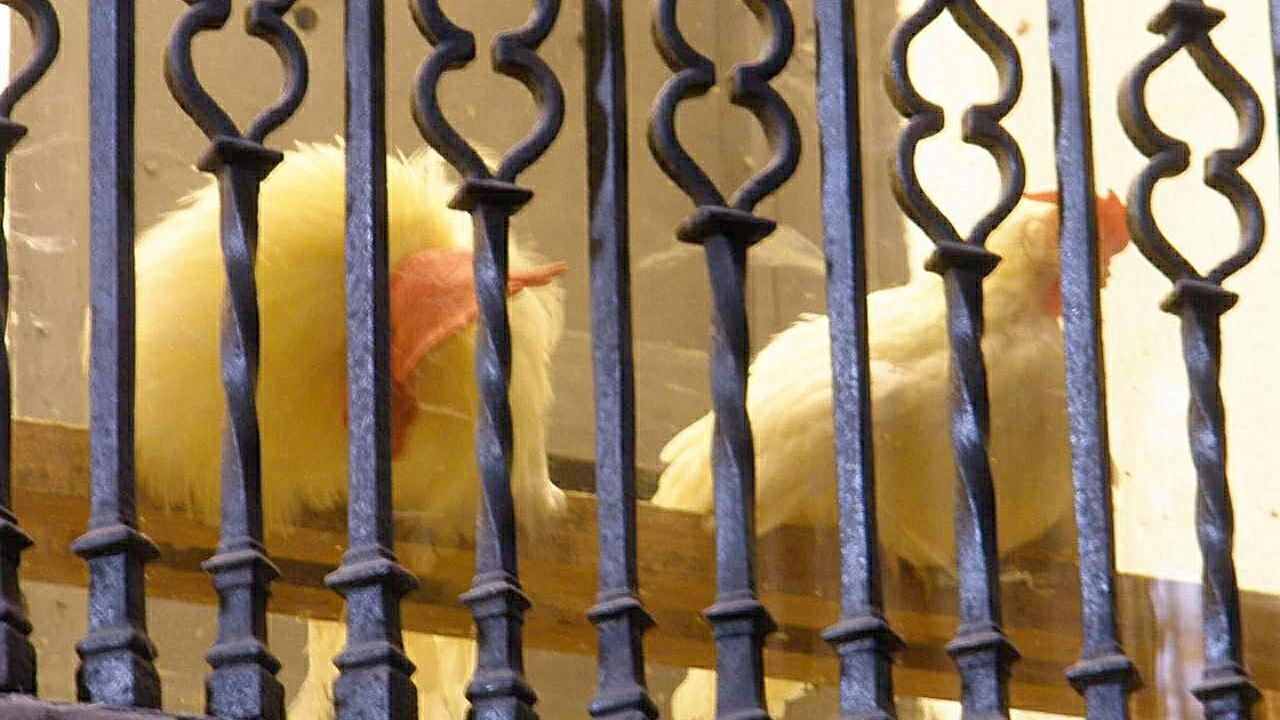
A white rooster and a white hen live in the cathedral of Santo Domingo de la Calzada. Ask why and the local legend takes you to a pair of gallows. Two parents have come to say goodbye to their son. He speaks to them. Now they have to persuade a judge, just sitting down to dinner, that the boy is alive.

Published on
The silver cup in the pilgrim’s bag
A young German pilgrim stopped at an inn in Santo Domingo with his parents on their way to Santiago. In the version told in La Rioja, his name was Hugonell. The innkeepers’ daughter wanted him to return her affection. When he turned her down, she hid a silver cup in his bag. She waited until the family had left, then raised the alarm.
The search went exactly as she intended. The cup was in the boy’s bag. He was convicted of theft and hanged. When his parents went to the gallows to say goodbye, their son spoke to them. Santo Domingo was holding him up by the feet, he said. They could still get him down.
The judge was about to eat
The parents went to the judge. He was about to carve a roast rooster and hen. Their son, he told them, was about as alive as the birds on his plate. At that, the birds sprouted feathers, leapt from the platter and began to sing. The pilgrim was taken down alive.
What the parents had seen at the gallows, the judge had refused to believe. Now the second marvel had happened at his own table. That is why the cathedral keeps a pair of birds: they are the part of the story in which someone finally believes the parents.
A henhouse older than the stone around it
You can date the custom more securely than the miracle. The cathedral cites a papal document from 1350 that already mentions live birds inside the church. The painted stone enclosure opposite the saint’s tomb came later, in 1460. The birds had a place here more than a century before they had this particular one.
In 1702 the town’s historian José González de Tejada recorded a practical detail: the birds were replaced from time to time. What passed from one generation to the next was the work of keeping a rooster and a hen in the church.
What pilgrims took away
The stage out of Nájera ends in Santo Domingo. In the cathedral, stand by the saint’s tomb and look up at the grille. La Rioja’s heritage account records what a pilgrim once hoped to take away: a fallen feather, tucked into a hat for luck on the road to Santiago.
Walks in this guide
These distances are for the whole walk. Open a route to see which stages you’d like to walk.
- Camino Frances
- Distance
- 784.5 km
- Stages
- 32 stages