Italian walking routes in numbers: 2025-2026
At least 300,046 people walked one of Italy’s cammini in 2025, according to the Terre di mezzo dossier compiled with CAST at the University of Bologna. This page sets that figure beside the others that explain the trend: spending, the Via Francigena, Santiago and Italy’s new law on walking routes. Each number names who measured it and for which period.

How many people walk, and what they spend
Terre di mezzo’s dossier “Italia, Paese di Cammini”, ninth edition, published on 12 March 2026 with CAST at the University of Bologna, estimates at least 300,046 walkers on Italian cammini in 2025. The figure for 2024 was 191,465, so growth was 56%.
It is a minimum estimate. Italy has no national register of walkers yet. The dossier collects the credentials and Testimonium certificates issued by route managers, adds a walker questionnaire (4,328 responses) and scales up to a total. The base changes every year: for 2025, 250 cammini were contacted and 160 supplied data, against 160 and 122 the year before. Part of the growth therefore comes from wider coverage.
The same dossier counts at least 2,476,880 overnight stays. Walkers spend an average of €87.29 a day on the route, excluding the journey to the start. CAST estimates a total economic impact of at least €336.4 million, mostly in Italy’s inland areas (aree interne).
Where walkers sleep and eat
In the previous edition’s questionnaire, with 4,622 responses about 2024, 46% of walkers slept in a B&B or apartment, 26% in a hostel, 16% in a hotel or agriturismo and 6% in religious hospitality. 77% ate dinner in a restaurant and 57% added holiday days after arriving.
Walkers’ spending therefore reaches mainly the small businesses of the villages they pass through: the room for the night, the dinner, the café that opens in the morning.
Terre di mezzo’s 2024 dossier on walker profiles (in Italian)
How many cammini does Italy have?
Italy’s Strategic Tourism Plan 2023-2027 states that Italy “today has over 70 cammini that issue a credential” and names the Via Francigena the backbone of the Italian walking routes. The figure dates from 2023, when the plan was approved.
The plan places the cammini both in religious and cultural tourism and in slow tourism, alongside inland areas, parks and heritage railways.
Italy’s Strategic Tourism Plan 2023-2027 (draft AG 39, section 10.4, in Italian)
Via Francigena in the Jubilee year
In 2025 the European Association of the Via Francigena handed out more than 19,000 credentials, 35.95% more than the year before, according to Il Sole 24 Ore on 21 February 2026. 53% of holders came from abroad and 14% travelled by bicycle. Departures peaked in September (19%), April (13%), May and October (12% each).
Credentials are not a count of walkers. The association says they represent about 15% of those who set out; Il Sole 24 Ore reports an estimate of about 100,000 people on the Via Francigena in the Jubilee year.
Santiago de Compostela: 530,987 pilgrims in 2025
In 2025 the Pilgrim’s Office (Oficina del Peregrino) in Santiago registered 530,987 pilgrims, a record and 6% more than in 2024. This is the year-end total the Office announced in January 2026.
The figure counts pilgrims registered at the Santiago welcome office, including those who state a non-religious motivation. That makes it the most reliable reference for comparing one year with another.
The January 2026 announcement (EWTN News / ACI Prensa, in Spanish)
Italians on the Camino de Santiago
On the Pilgrim’s Office statistics dashboard, accessed on 4 November 2026, 26,624 Italians registered in 2025, 5.02% of the total: the third nationality after Spain and the United States, and the second foreign country. In 2026, up to 3 November, there were already 43,720 (7.79%), more than in any full year of the series.
The same dashboard shows two patterns worth knowing when planning. In 2025, 30.51% of pilgrims started in Sarria, just over the 100 km minimum for the Compostela. And 83.1% arrived between May and October (our calculation from the Office’s monthly figures).
On the Office’s figures, registered pilgrims doubled from 2015 to 2025 (2.02 times), about 7.3% more each year (our calculation).
What Italy’s 2026 law on the cammini does
Law no. 24 of 13 February 2026, “Provisions for the promotion and enhancement of the cammini d’Italia”, has been in force since 26 February 2026 (Gazzetta Ufficiale, General Series no. 46 of 25 February 2026). It defines cammini as routes travelled on foot or by other forms of soft, non-motorised mobility, including waterways.
It sets up a national database of the cammini d’Italia at the Ministry of Tourism, with a digital map; routes entered in it receive the title “cammino d’Italia”. It also provides for a national steering group, a permanent forum with associations, universities and operators, a three-year national programme, an annual report to Parliament and promotion campaigns in Italy and abroad. Regions keep their power over regional and local routes.
The funding: for the database, €1 million in 2026 and €500,000 a year in 2027 and 2028, plus €50,000 a year from 2028 to run it; for promotion campaigns, €1 million a year from 2026.
The law in the Gazzetta Ufficiale no. 46 of 25 February 2026 (in Italian)
Walking routes on AppyPilgrim
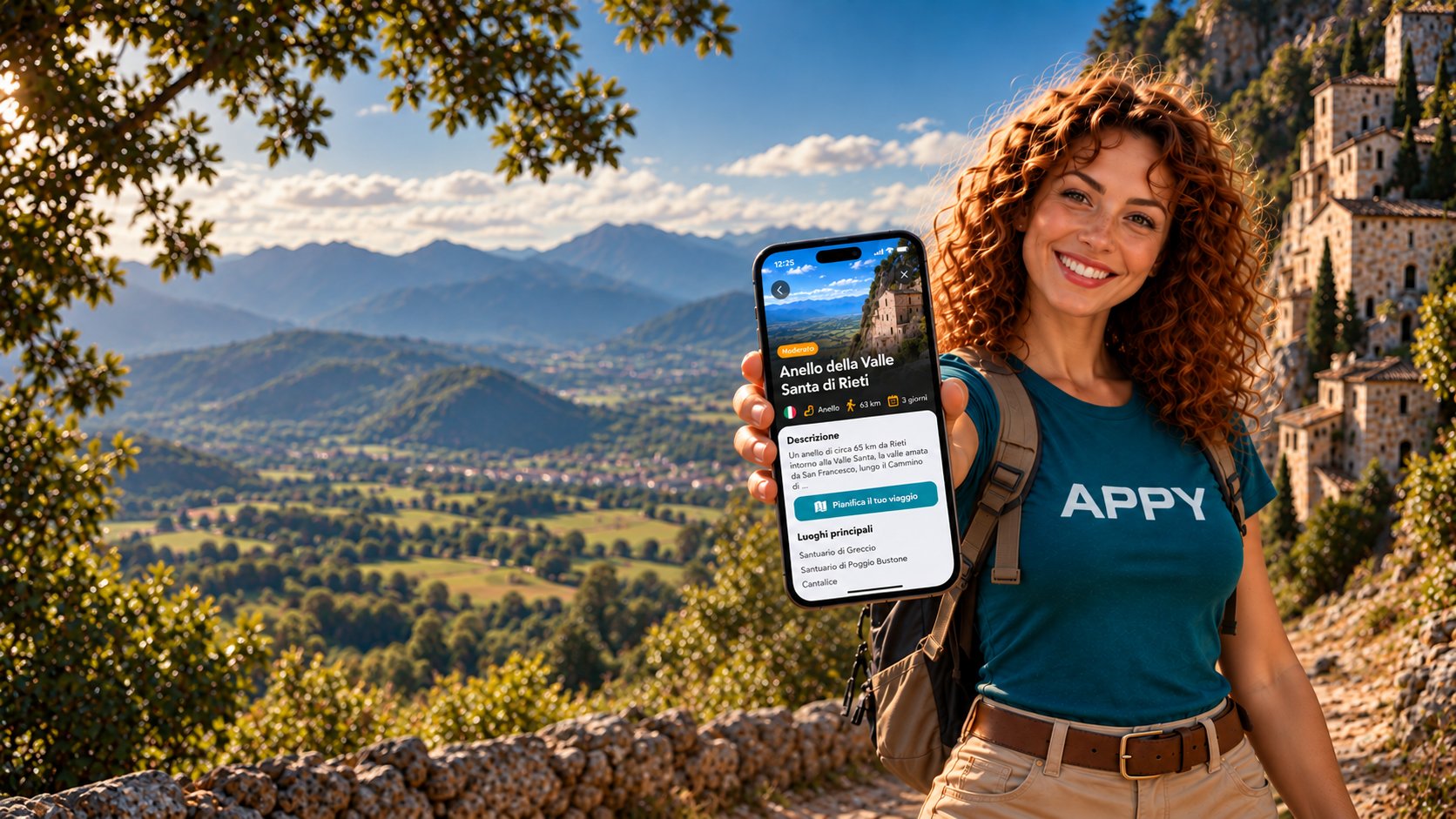
AppyPilgrim has 134 live walking routes in 9 countries, 93 of them in Italy: 1,292 main-line stages covering 26,459 km, with 71,047 linked points of interest. This is AppyPilgrim’s own count on 17 November 2026, not the Ministry’s catalogue.
On the website you can compare routes and open each stage with its distance and elevation. In the app the same stage comes with its map and step-by-step guidance along the way, and the Appy Pro assistant runs on your phone even without a connection.
Before you go
- Collect a credential from the manager of the route you plan to walk
- If you can, consider weeks outside May to October
- Book overnight stays in the smaller villages early
- Check stages, distances and the journey home on the route page
Sources for this guide
- Terre di mezzo’s 2025 dossier (in Italian)
- Terre di mezzo’s 2024 dossier on walker profiles (in Italian)
- Italy’s Strategic Tourism Plan 2023-2027 (draft AG 39, section 10.4, in Italian)
- Il Sole 24 Ore on the Via Francigena’s 2025 figures
- The January 2026 announcement (EWTN News / ACI Prensa, in Spanish)
- The Pilgrim’s Office statistics
- The law in the Gazzetta Ufficiale no. 46 of 25 February 2026 (in Italian)